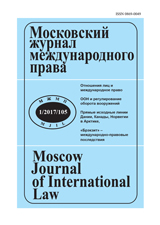
Scientific and practical peer-reviewed journal
The scientific journal Moscow Journal of International Law, formerly the Soviet Journal of International Law, established in 1991, is published by the Moscow State Institute of International Relations is a high quality peer reviewed journal, and is one of the leading international law journals in Russia.
The Journal publishes scholarship on diverse issues ranging from issues of theory of international law, legal problems of international security, questions of international humanitarian law, space law, air law, diplomatic and consular law, international maritime law, law of international treaties, to correlation between international and national law. The Journal has repeatedly focused attention on the issues of territory in international law, international ecological law, various aspects of international private, business, investment and tax law. Young authors are traditionally welcomed – undergraduate and post graduate students of law faculties. And finally, and this is one of the important assets, the Journal has published numerous international conventions, documents of international organizations, bilateral agreements and laws of the Russian Federation.
The target audience of the journal comprises lawyers, research scholars, university professors, post-graduates and undergraduate students from Russian and international universities, policy-makers, businessmen, official of international and non-governmental organizations and others who are interested in theory and practice of International law.
Current issue
ISSUES OF THEORY OF INTERNATIONAL LAW
INTRODUCTION. This article examines the impact of the Agreement on Trade-Related Aspects of Intellectual Property Rights (TRIPS) on domestic legislation regarding the cross-border protection of intellectual property rights. This agreement is the universal international standard for the protection of intellectual property rights in international trade. In the context of digitalization, economic crisis, and geopolitical tensions, issues related to the implementation of TRIPS provisions require new assessment approaches.
MATERIALS AND METHODS. The study utilized methods including systems analysis, comparative legal analysis, classification, historical analysis, problem-based analysis, and formal legal analysis.
RESEARCH RESULTS. The authors identified two key aspects of the impact of TRIPS provisions on Russian national legislation, including in the context of Eurasian economic integration. The first aspect is the unification of border measures for the protection of intellectual property rights and is expressed in the convergence of administrative procedures for such protection. The second aspect is reflected in the regulation of the principle of exhaustion of exclusive rights to intellectual property. Based on an analysis of scientific literature and regulatory materials, this article assesses the incorporation of TRIPS provisions into domestic legislation and the law of the Eurasian Economic Union.
DISCUSSION AND CONCLUSIONS. The analysis reveals the positive impact of TRIPS provisions on the formation and development of border measures to protect intellectual property rights during the crossborder movement of goods containing intellectual property. Regarding the principle of exhaustion of rights, the recommendatory nature of its enshrinement in TRIPS has prevented its unification in the states parties to the agreement. This article concludes that the idea of unifying the principle of exhaustion of rights is irrelevant in modern interstate economic relations. It also notes the need to develop national models of the principle of exhaustion of exclusive rights and prioritize the regulation of these issues through bilateral international treaties.
INTRODUCTION. This article embodies a thorough study of the current national treaty massif in the area of bilateral cooperation between the Russian Federation and foreign countries on social security (pension) matters. The present article categorizes these international treaties, describes their key characteristics, outlines inherent advantages meanwhile also identifying their common shortcomings. The relevance of the study is due to the high need to develop and adopt new international treaties of the Russian Federation in the field of social (pension) security. This is primarily relevant when it comes to the treaties with the member states of the Commonwealth of Independent States (hereinafter referred to as the CIS) in light of the recent denunciation of the Agreement on Guarantees of the Rights of Citizens of the CIS Member States in the Field of Pension Provision dated March 13, 1992 by the Russian Federation. Based on the data obtained during the review, a proposal was made for further expansion of the bilateral legal framework in this area.
MATERIALS AND METHODS. The main emphasis in the work is made on the subject study of the most representative sample of current bilateral international treaties of the Russian Federation, dedicated to pension provision for various categories of the population. The methodology of this research is based on some certain general theoretical methods, specifically the formal-logical method, deduction and induction, analysis and synthesis. In addition to all of the mentioned above, specific scientific methods such as historical and comparative legal ones were employed while preparing the article.
RESEARCH RESULTS. Upon the completion of the study, it was concluded that, of all the types of bilateral agreements regulating relations in the sphere of pension provision, those based on a proportional pension model are the most effective in protecting workers' rights and interests and the most just in terms of distributing the financial burden of pension payments. However, it was emphasized that, regarding agreements concluded with countries formerly part of the USSR, a hybrid model is quite feasible. Under the latter pension payments for work experience acquired up to and including January 1, 1991, are made by the individual's state of permanent residence.
DISCUSSION AND CONCLUSIONS. It was noted that, given the imposition of unilateral economic restrictions by most European Union member states on the Russian Federation, the practical implementation of bilateral agreements with these countries is extremely hampered. The reason for that is the impossibility of transferring to their territories pensions allocated to Russian citizens which gives rise to the problem of infringement of the rights of Russian citizens. Such issue requires a long-term solution, which is not possible without the coordinated efforts from all the involved agencies, using, inter alia, diplomatic means.
INTRODUCTION. The article essentially deals with the legal mechanism of challenging the Eurasian Economic Commission’s (EEC) acts in the sphere of antimonopoly regulation by individuals in relation to their right of access to justice.
MATERIALS AND METHODS. The methodology in the paper contains the following tools: general scientific and formal-logical methods (including methods of analysis, synthesis, comparison, analogy, systematization, and modeling), as well as special methods (formal-legal, historical, and comparative analysis).
RESEARCH RESULTS. It is concluded that the competence to resolve these disputes is partially conveyed by collective lawmakers of the Eurasian Economic Union (EAEU) to the Court of the EAEU. At the same time the judicial body of the EAEU is not authorized to hear cases initiated by individuals (who are not entrepreneurs) in which the EEC’s acts on liability of antimonopoly violations are challenged. Using the decisions of Russian courts the authors demonstrate that national courts cease the proceedings initiated by individuals who are not entrepreneurs. Moreover, considering the position of the Supreme Court of Russian Federation formulated on the ground of the EEC’s complaint, Russian courts concluded that the Court of the EAEU has exclusive competence to consider claims of individuals to challenge acts of EEC in the sphere of antimonopoly regulation. Thus, natural persons (except for entrepreneurs) who were punished by the EEC for violation of general competition rules, seem to be deprived of their right of access to justice. Consequently, the legal gap revealed upon the implementation of the EAEU law may obviously lead to the crisis of the EAEU justice system.
DISCUSSION AND CONCLUSION. Therefore, to prevent the above-mentioned crisis, the authors recommend amending both the Treaty on the EAEU and the procedural acts in the sphere of the transnational antimonopoly regulation adopted based on the Treaty on the EAEU. These amendments should establish the right of individuals (who are not entrepreneurs) to challenge acts, actions (inaction) of the EEC in the sphere of antimonopoly regulation in the Court of the EAEU. Furthermore, in the authors view, this should be done before the complaint of an individual regarding the constitutional right to judicial protection may be raised before one of the EAEC member states’ constitutional courts.
HUMAN RIGHTS
INTRODUCTION. If the legal recognition of human rights depends on belonging to “all members of the human family”, then the existence of the scope of application of human rights ratione loci is logically contradictory. Either there should be no territorial restrictions on the application of human rights, or the provisions of the Universal Declaration of Human Rights are false. This contradiction affects the basic feature of human rights, and therefore, being a contradiction, in the future it may serve as a driver for transforming the concept in a dialectic vein. This article suggests imagining how this could happen and what it could entail.
MATERIALS AND METHODS. In this paper, an attempt is made to consider the further development of human rights in a dialectical way. Based on the existing studies of the European Court’s of Human Rights (hereafter ‒ ECtHR) practice on the extraterritorial application of the European Convention on Human Rights (hereafter ‒ ECHR), two main approaches (territorial and personal) are described. Analysing the approaches, two statements are formulated that create an internal contradiction to a concept of the scope of application of human rights ratione loci. The contrast created by the peculiarities of the ECHR's human rights protection mechanisms, as well as the accents that were stressed by the developing functional approach, allowed us to determine which change could resolve the formulated contradiction. The analogy with Roman law, in turn, allowed for projecting possible problems of implementing such changes.
RESEARCH RESULTS. The dilemma of the universality of human rights and the limitations of their extraterritorial application can be resolved through the concept of natural obligations if one breaks the logically necessary link between rights and remedies, putting them under different grounds of existence. The analogy with Roman law allowed us to conclude that such a solution to the dilemma is dangerous for both obliged and entitled persons, which makes such a development unlikely. However, if the formulation of the contradiction is correct, then this path may be the only possible one.
DISCUSSION AND CONCLUSIONS. By placing human rights and remedies on different grounds, the problem of extraterritorial application is resolved at the cost of triggering (or exacerbating) others. The concept of human rights would go far beyond the legally relevant issues, trespassing into the domain of ethics; if one strictly follows the analogy of Roman law, a significant part of modern human rights law risks being outside the borders of jurisprudence. However, the difference between Roman law and modern international law, which consists in the absence of one common "state", may become an important incentive for adapting the idea of natural obligations. Nevertheless, this idea may make it possible to create a clear focus of international human rights law on the remedies on the international plane, diverting attention from proclaiming them; perhaps this will reduce the number of formal legal arguments in favour of human rights violations in the framework of political communication on the international arena.
INTERNATIONAL ECONOMIC LAW
INTRODUCTION. Internal taxes to exports are imposed by countries in the exercise of their sovereign rights. Upon accession to a treaty, tax sovereignty may be limited. This has happened twice in China's history. If the first time was the result of the Opium wars, then the second time was the WTO accession and the restriction remains in force today. In the given article the issues of international regulation of export duties in China, including practices within the WTO dispute settlement system, are discusses.
MATERIALS AND METHODS. This study is based on data from publications on the history of China's customs tariffs, provisions of treaties, national legislation, and reports of panels and the WTO Appellate Body. Comparative legal and formal logical methods were used in the research.
RESEARCH RESULTS. Throughout China's history, various types of customs duties have been imposed. The customs legislation of the People's Republic of China is limited in area. It does not apply in the Hong Kong and Macao Special Administrative Regions, as well as in the Republic of China (Taiwan). After the proclamation of the PRC, there have been no bilateral international agreements limiting the use of internal taxes to exports. GATT does not prohibit the application of export duties, but upon accession to the WTO, countries may commit to limit their use. These obligations are provided in the accession protocol, which is an integral part of the WTO Agreement.
DISCUSSION AND CONCLUSIONS. In several cases, the WTO panels found that China may not seek to justify the application of export duties by reference to the protection of human life or health, as well as the conservation of exhaustible natural resources, pursuant to art. XX GATT. At that time, the PRC's Law on International Relations had not yet entered into force, the provisions of which prohibit the execution of treaties that cause damage national sovereignty, security and public interests. Theoretically, in the future, the PRC may use the relevant provision of national legislation not to fulfill, among other things, the so-called WTO-plus obligations. However, this will amount to a violation of obligations under the WTO Agreement.
INTRODUCTION. This study examines the legal compatibility of unilateral economic sanctions with fundamental principles of international law. The research addresses growing concerns about the systematic violation of state sovereignty and non-intervention principles through economic coercion mechanisms employed by economically powerful states.
MATERIALS AND METHODS. The analysis encompasses decisions of the International Court of Justice, International Law Commission documents, UN resolutions, national legislation of sanctioning states, and contemporary international legal doctrine. The methodology includes formal legal analysis, comparative law approach, and systematic examination of state practice, with particular focus on US and EU sanctions against Russia, Iran, Cuba, and other states.
RESEARCH RESULTS. The research demonstrates that contemporary unilateral sanctions fundamentally differ from traditional inter-state coercion mechanisms (retorsions and countermeasures) and cannot be justified through existing lawful self-help institutions. Most unilateral sanctions fail to meet the criteria for lawful countermeasures: they are imposed by non-injured states, introduced without prior bilateral obligation violations, violate proportionality requirements, and often aim at regime change. Three primary mechanisms of international law violation are identified: creation of de facto state hierarchy contrary to sovereign equality principle, systematic interference in domestic jurisdiction through economic coercion, and exceeding limits of lawful sovereignty through treaty obligation breaches and violations of general law principles.
DISCUSSION AND CONCLUSIONS. The study reveals that unilateral sanctions transform international law from an equal rules system into a political hierarchy maintenance tool. Extraterritorial and secondary sanctions create dual sovereignty violations, coercing both target states and third countries. Violations of good faith, proportionality, and clean hands doctrine demonstrate sovereignty's transformation into a political dominance mechanism. International court decisions (Alleged Violations of the 1955 Treaty of Amity, Economic Relations, and Consular Rights case, Russia WTO case) confirm the unlawfulness of numerous sanctions measures. Unilateral economic sanctions represent a systematic challenge to contemporary international legal order, creating a "parallel" legal system where economically powerful states assume legislative, judicial, and enforcement functions. Development of international legal mechanisms for restricting arbitrary economic coercion and procedural guarantees for target states is urgently required.
INTRODUCTION. Contemporary international relations are characterized by a high degree of transformation due to the formation of a multipolar world, geopolitical and geo-economic changes, which creates challenges for the international community in trying to solve them. Due to the substantially changed configuration of international relations, as well as the shifting of global economic centers, the countries of the West, seeking to maintain the position of leading economic powers, attempted to use unilateral restrictive measures against States that do not share the Western vision of a fair world trading system as an instrument of political and economic pressure. Significant consequences of such decisions are the violation of constitutive principles of international trade law, increasing protectionism in world trade, undermining free trade system, disruption of logistics chains, formation of economic alliances, as well as the fragmentation of world trade. Violation of fundamental principles of international trade law through the application of unilateral restrictive measures has created economic and legal preconditions for their circumvention in order to ensure economic security and the adaptation of States in the current conditions. Parallel imports are one of the tools for levelling the effects of unilateral restrictive measures. The international legal assessment of the legitimacy of parallel imports depends on the chosen and nationally determined regime of exhaustion of exclusive rights (Article 6 of the Agreement on Trade-Related Aspects of Intellectual Property Rights (TRIPS).
The purpose of this article is to examine the legality of parallel imports from the point of view of exhaustion of exclusive rights, as well as to analyse the transformation of approaches to its assessment in the context of the application of unilateral restrictive measures.
MATERIALS AND METHODS. For the purposes of this study, the authors analyzed international legal acts that constitute the basis of the international system of protection of intellectual property rights, constitutive acts of integration associations in terms of regulating the protection of intellectual property rights, national legislation and judicial practice of individual states, as well as the work of domestic and foreign researchers in the field of international economic, trade and private law. During the writing of the article applied general (analysis, synthesis, induction, deduction, forecasting) and special legal methods (formal-legal, comparative-legal) scientific knowledge.
RESEARCH RESULTS. Based on the analysis of the legitimacy of parallel imports in terms of the basic principles (regimes) of exhaustion of exclusive rights, taking into account current political and economic realities, the authors concluded that their division is conditional and there is a tendency to form a «mixed» exhaustion regime. Unilateral restrictive measures against a number of States have shown the inefficiency of the regional and national regime of exhaustion of exclusive rights in conditions of political and economic instability, as well as their lack of conformity with the principles of freedom and trade liberalization.
DISCUSSION AND CONCLUSIONS. The debate on the possibility and legality of parallel imports at the international legal level lies in the definition of their economic and legal nature and is related to the specificity of its interpretation within different legal systems. Parallel imports are one of how States can gain access to goods, in particular critical goods, and contribute to the formation of economic blocks within which free movement of goods is possible. The application within a State or an integration association of an international regime of exhaustion of exclusive rights minimizes the possibility of exerting economic pressure on them to achieve specific objectives.
INTRODUCTION. In the context of the profound transformation of international trade relations, there is a particular emphasis on the legal assessment of subsidies in both academic discourse and legal practice. As a tool of state economic policy, subsidies can have a significant impact on competition and market access, which makes their use subject to assessment in accordance with the international trade rules. The article considers subsidies as a complex legal phenomenon. On the one hand, they are a tool of state regulation used for various purposes, including achieving technological sovereignty. On the other hand, their universality raises the question of their appropriate legal form, as they continue to be an instrument of trade policy, industrial support, and technological development. Therefore, the article discusses cases from academic and expert legal literature related to issues of national security, technological sovereignty, and complex legal structures that may include subsidies, according to the author's opinion.
MATERIALS AND METHODS. The hypotheses of the article are based on the author's analysis of 26 different concepts of subsidies, which are used at international, regional, and national levels. Data from international institutions' reports have also been analyzed. Some institutions have their own definitions of subsidies to, for example, count them and prepare statistics on state support measures. While preparing the article, the author used a structural-semantic approach, incorporating elements of multi-criteria evaluation. This approach combines semantic decomposition, comparative law and mathematical analysis. The research has shown that each regulatory body gives its own meaning to the definition. However, it is a challenging task to identify this meaning, but it can be done through a combined methodological approach. The hypotheses of the article are based on the analysis of various approaches to the conceptualization of technological sovereignty and the role of subsidies as an instrument of state support that allows for asymmetrically damping the increasing pressure of AI in economic relationships.
RESEARCH RESULTS. The study showed that international trade rules developed within the WTO system consider subsidies from the position of the mechanism for their provision, recipient and distributor of support. However, much less attention is paid to the intended purpose of subsidies. Subsidies are considered only from the position of obtaining an advantage. That is why there is a need to adjust subsidy models. It is becoming fundamentally important to ensure rational subsidies aimed at the effective use of public resources, creating conditions for the development of modern technological production and meeting national goals for economic development.
DISCUSSION AND CONCLUSIONS. The integrated use of subsidies, which is aimed not at achieving price advantages but at multitasking and achieving technological independence, can be seen as a new and innovative approach to using state funds. In this regard, regulation should be more flexible, and its rules should no longer be limited to specific sectors. Instead, they should be targeted at achieving the greatest beneficial management impact. Therefore, as the author suggests, the legal constructs describing the instruments of regulation can be seen as a flexible, rather than a rigid system, especially in the current technological era. It is important to consider the dynamism and interconnection of various legal norms and institutions. This will allow us to more effectively reflect the dynamics of social, political, and economic reality in regulatory matters.
INTERNATIONAL PRIVATE AND CIVIL LAW
INTRODUCTION: Resolution by the Court of Appeal of Paris in 1888 of a dispute over the legacy and further publication of certain musical works created by Frederic Chopin arises new reflections on application of rules of private international law (conflict-oflaw rules as well as material criteria used by courts to imply national law to foreign works). The analysis of the said decision, and mostly of the motivation proposed by judges to support the final resolution (widely contested by French legal researchers as non-accurate), allows nevertheless to turn once more to Intellectual Property basis (such as its ownership concept and duration of copyright rules) and to demonstrate the influence it makes on international private matters. An analysis of a peculiar surface of the court's motivation laid down for rendering the decision makes it possible to demonstrate a way of localization and the importance of occasional circumstances and subjective considerations applied to create an individually applied court rule.
MATERIALS AND METHODS. The study used awide range of works written by French, pre-revolutionary Russian, Soviet and modern Russian, English and American researchers of Intellectual Property Law and of International Private Law of the 19th through 21st centuries. An abbreviated text of the commented decision is included as well. It applied general scientific and special scientific methods (including historical-legal andformal-legal methods). RESEARCH RESULTS. The commentators join the negative opinion on the motivation choose by the Court of Appeal to support its final statement about the French copyright law rules as due to be applied in this case. Instead of autonomy of will (lex voluntatis), being obviously a non-accurate groundation, a criterion of first revelation (publication) as the most relevant.
DISCUSSIONS AND CONCLUSIONS. Criterion of the place of publication of work (under the following international and national legislation - along with personal criterion relating to nationality of its author) is certain to be primarily taken into consideration in the scope of transnational copyright.
INTRODUCTION. The article analyses the prospects for the codification of civil law in the states that emerged on the territory of the former Yugoslavia within the framework of the Romano‑Germanic legal family and contemporary trends towards systematic codification of private law. The study covers Bosnia and Herzegovina, North Macedonia, Serbia, Slovenia, Croatia and Montenegro, and identifies how historical development, the Yugoslav legal legacy and post‑socialist transformations have shaped their current codification agendas. It is shown that, despite decades of discussion and the preparation of draft codes, these states still lack a unified civil code, and the regulation of private‑law relations remains fragmented.
MATERIALS AND METHODS. The methodological basis of the study consists of comparative‑law, historical‑legal and institutional analysis. The empirical basis includes the national legislation of the six post‑Yugoslav states, primarily statutes governing property, obligations and family relations, as well as official documents and materials of codification commissions. The research further relies on academic literature in several languages, including works on civ‑il‑law codification in Central and Eastern Europe; in the historical‑legal part particular attention is paid to the impact of the Austrian Civil Code and the broader Austro‑Hungarian legal legacy.
RESEARCH RESULTS. The analysis shows that the six post‑Yugoslav states display different models of civil‑law development. In North Macedonia, Serbia and Montenegro large‑scale codification projects are underway, yet progress towards the adoption of civil codes remains uneven and politically vulnerable. Slovenia and Croatia continue to rely on the Yugoslav Law on Obligations, modernising it through incremental reforms instead of enacting a single civil code. In Bosnia and Herzegovina, state‑wide codification is seriously hampered by its complex constitutional structure. Throughout the region, the Yugoslav model of regulating private law through a set of specialised statutes retains its influence; this is complemented, in several jurisdictions, by the historical impact of Austria‑Hungary and reliance on the Austrian Civil Code in the development of property‑ and obligations‑law institutions.
DISCUSSION AND CONCLUSIONS. The analysis demonstrates that the post‑Yugoslav states are at different stages of civil‑law codification: from advanced civil‑code projects in North Macedonia, Serbia and Montenegro to a more cautious strategy of step‑by‑step reforms in Slovenia and Croatia and significantly constrained state‑wide codification in Bosnia and Herzegovina. A key condition for progress is political will, without which even thoroughly elaborated drafts remain at the level of expert initiatives. At the same time, the academic communities in all the countries considered are broadly unanimous in viewing civil‑law codification as a necessary and desirable goal that enhances the coherence and predictability of legal regulation. The codification process is shaped by persistent historical patterns: the Austro‑Hungarian legal heritage and the specific socialist trajectory of the Yugoslav federation, which relied on the Law on Obligations instead of a classical civil code. These layers of tradition determine differing starting points and models of possible codification, but do not negate the basic direction of development: movement towards civil‑law codification in all the countries analysed, albeit in asynchronous and institutionally diverse forms, is largely predetermined by their belonging to the Romano‑Germanic legal family and by the requirements of European integration.
INTERNATIONAL ENVIRONMENTAL LAW
INTRODUCTION. The purpose of this article is to analyze international law in conjunction with the Russian regulatory framework for limiting harmful greenhouse gas emissions in order to formulate proposals for its development. This goal determines the objectives of the study, including the consideration of constitutional provisions laying the foundation for ensuring environmental well-being in Russia, the study of the Paris Agreement and other international acts with a similar subject of regulation only worldwide, the formation of individual arguments in favor of carbon law as a major legal institution aimed at limiting harmful anthropogenic impact on the atmospheric environment. The air, as well as the formulation of proposals for the modernization of international law and domestic legislation in the broadest sense of the word.
MATERIALS AND METHODS. The main research method was the analysis of regulatory legal regulation. In addition, new mandatory rules of conduct were modeled. The deductive method was used to examine international law in the field under consideration and its implementation in Russian realities, both from the point of view of legislative activity and from the perspective of law enforcement. The legal regulation of greenhouse gas emissions control is a complex structure, in connection with which the method of system analysis was also used. The comparison method was used when considering the practice of implementing international standards in the territory of individual States. In particular, the focus is on comparing developed, developing and underdeveloped countries.
RESEARCH RESULTS. Regarding the latter, the conclusion is drawn about the vulnerability of sovereignty and the prospects for the influence of the "collective West" on the rest of the world, including through the implementation of publicly significant measures aimed at limiting harmful emissions. In addition, it is proposed to stimulate the activation of absorption, thereby shifting the focus to reducing greenhouse gas emissions directly into the atmosphere. Another conclusion is the formulation of the need to legally consolidate the involvement of a wide variety of subjects in the process of limiting greenhouse gas emissions. This problem should not be relevant only for public law entities, the maximum number of legal entities should be involved in this process, which can solve not only organizational, but also educational tasks on the way to purifying atmospheric air, which is so important for everyone, without exception.
DISCUSSION AND CONCLUSIONS. The international legal approach related to the distribution of States by level of development in the process of countering greenhouse gas emissions has not only a positive effect. This gradation makes the sovereignty of developing and poorly developed countries vulnerable, since developed countries not only provide support, but also integrate models of such public legal activities into the relevant legal order. This is another way of political influence of the "collective West" through legal instruments, including on domestic socially significant processes. In current law and practice, the exchange of carbon units is developing, which are more emissions oriented. At the same time, it seems promising to stimulate absorption with the subsequent formation of certain analogues. Thus, of course, it will not be possible to radically change the environmental situation, but it can be an additional contribution to the overall improvement of atmospheric air. A promising direction for the development of carbon law is the involvement of the maximum number of subjects in the process of countering greenhouse gas emissions. This area of activity should not be exclusive state competence. Commercial organizations, public associations, and other civil society institutions can contribute to improving the environmental situation to the best of their ability with the prospects of stimulating these activities.
RUSSIAN LEGISLATION AND EU LAW
INTRODUCTION. This article examines a pressing issue of human-rights protection arising in the inheritance of digital objects that have no economic value or have an indeterminate economic value and are closely linked with the decedent’s private life (hereinafter “digital objects of a personal nature”). Such objects include accounts on online platforms, electronic correspondence, personal photographs, and other forms of digital self-expression that constitute an integral part of a modern individual’s private life. Upon a person’s death, a complex set of questions arises in the field of succession law, personal data protection, and the safeguarding of non-pecuniary personal rights. The purpose of the study is to identify legal gaps and inconsistencies in this area, to conduct a comparative analysis of emerging approaches to addressing them within EU law and in the national law of foreign states, and to assess the prospects for developing relevant regulation in the Russian Federation, taking into account the specific features of the domestic legal system.
MATERIALS AND METHODS. The theoretical foundation of the study is based on scholarly works by domestic and foreign legal scholars, including experts in EU law, the national law of foreign states, and Russian law. The research methodology includes the methods of analysis and synthesis, induction and deduction, as well as the comparative legal method and the formal legal method. The empirical basis of the study comprises EU legal acts, the norms of the national law of foreign states and the Russian Federation, user agreements, and case law.
RESULTS. The analysis shows that there is currently no unified approach to regulating the inheritance of digital objects of a personal nature. EU law protects the digital data of living persons; however, with respect to the data of deceased persons, no supranational data-protection regime has been established, and regulation is possible at the national level. EU Member States demonstrate a variety of approaches, ranging from including proprietary rights and obligations arising from user agreements with online platforms in the estate to recognizing lifetime dispositions concerning the fate of digital data and granting heirs (or other authorized persons) powers to exercise certain rights with respect to the deceased person’s personal data under national legislation. Legal regulation in the United States of America provides a procedural hierarchy that places the decedent’s intent at the forefront. In Russia, there is no direct regulation and judicial practice in this area remains underdeveloped. The situation is further aggravated by the fact that mandatory rules of succession law defining the composition of the estate do not provide an unambiguous answer as to whether certain types of digital objects form part of the estate; as a result, online platforms often restrict heirs’ access, referring to the terms of their user agreements. At the same time, domesticlegisla tion provides certain legal protection mechanisms that can be applied to digital objects as well.
DISCUSSION AND CONCLUSIONS. Digitalization requires the adaptation of traditional successionlaw constructs. To effectively regulate the inheritance of digital objects of a personal nature, Russia needs to develop existing legal mechanisms in a consistent manner. The priority directions for legislative improvement proposed are: first, to legally recognize the possibility for an individual to make a lifetime digital directive determining the fate of their accounts and personal data, which could be implemented through amendments to the Federal Law “On Personal Data” (July 27, 2006 No. 152-FZ); second, to expand the powers of the executor of the will, granting them a statutory right to interact with online platforms in order to carry out the decedent’s intent or protect their digital legacy; and third, to develop a mechanism that takes into account the legitimate interests of all stakeholders. Only a comprehensive approach that considers both the autonomy of the decedent’s will and the need for procedural safeguards for all participants in digital relations can overcome legal uncertainty and ensure effective human rights protection in the digital age.
Announcements
2026-04-13
Расширенное заседание Редколлегии «Московского журнала международного права»
23 марта состоялось расширенное заседание Редколлегии «Московского журнала международного права», учредителями которого являются МГИМО и Международный союз юристов, объединяющий общественные объединения правоведов государств — бывших республик СССР. Встреча была приурочена к 35-летию Московского журнала международного права.
| More Announcements... |

ISSN 2619-0893 (Online)